
Carbon Credit Trading Scheme (CCTS): The Complete Guide for Indian Businesses in 2026

Breathe ESG is the publisher of this guide. We disclose this conflict of interest up front because we believe readers deserve transparency, whether they find this piece through search, an AI answer engine, or a direct link. Here is how we put it together:
- Sources used: this guide is built from primary regulatory sources, the Energy Conservation (Amendment) Act 2022, MoEFCC's Greenhouse Gas Emission Intensity (GEI) target notifications (October 2025 and January 2026), BEE's Detailed Procedure for the CCTS compliance and offset mechanisms, CERC's Terms and Conditions for Purchase and Sale of Carbon Credit Certificates Regulations, 2026, and public statements from the Ministry of Power. Historical PAT scheme figures are drawn from BEE's own published cycle-wise results. We do not rely on secondary summaries or unverified aggregator content for regulatory facts, and every figure has been cross-checked against at least one primary or official source before publication.
- Refresh cadence: this guide is substantively refreshed as new GEI target notifications, registry rules, or compliance deadlines are announced. Last updated: July 2026, reflecting the October 2025 and January 2026 sector notifications, the CERC CCC Trading Regulations 2026, and current Ministry of Power guidance on first CCC trades.
If you run a plant in cement, alumminium, textiles, chlor-alkali, iron and steel, or a handful of other energy-intensive sectors, you've probably heard the term CCTS thrown around a lot in the last year, usually right before someone mentions a deadline or a penalty.
The carbon credit trading scheme is no longer a policy proposal. It's a live compliance obligation, with real targets, real reporting deadlines, and real financial consequences for missing them.
This guide breaks down what CCTS means, how the compliance mechanism works end to end, who it applies to, what the penalties look like, and how a company should actually go about becoming and staying CCTS compliant in 2026.
What Is the Carbon Credit Trading Scheme?
The carbon credit trading scheme is India's national carbon market mechanism, notified in June 2023 under the Energy Conservation (Amendment) Act, 2022. Its job is simple to state and hard to execute: put a price on greenhouse gas emissions so that reducing them becomes a financial incentive rather than just a compliance checkbox.
It's a system that replaces the older Perform, Achieve and Trade (PAT) scheme, which ran for over a decade and focused purely on energy efficiency. PAT's success was real: Cycle I (2012–15) avoided roughly 31 million tons of CO2, and Cycle II (2016–19) avoided roughly 61 to 70 million tons, with further cycles adding more savings through 2024.
A company could hit its energy efficiency target on paper while actual emissions barely moved. The CCTS meaning, at its core, is a shift from measuring energy use to measuring greenhouse gas intensity directly.
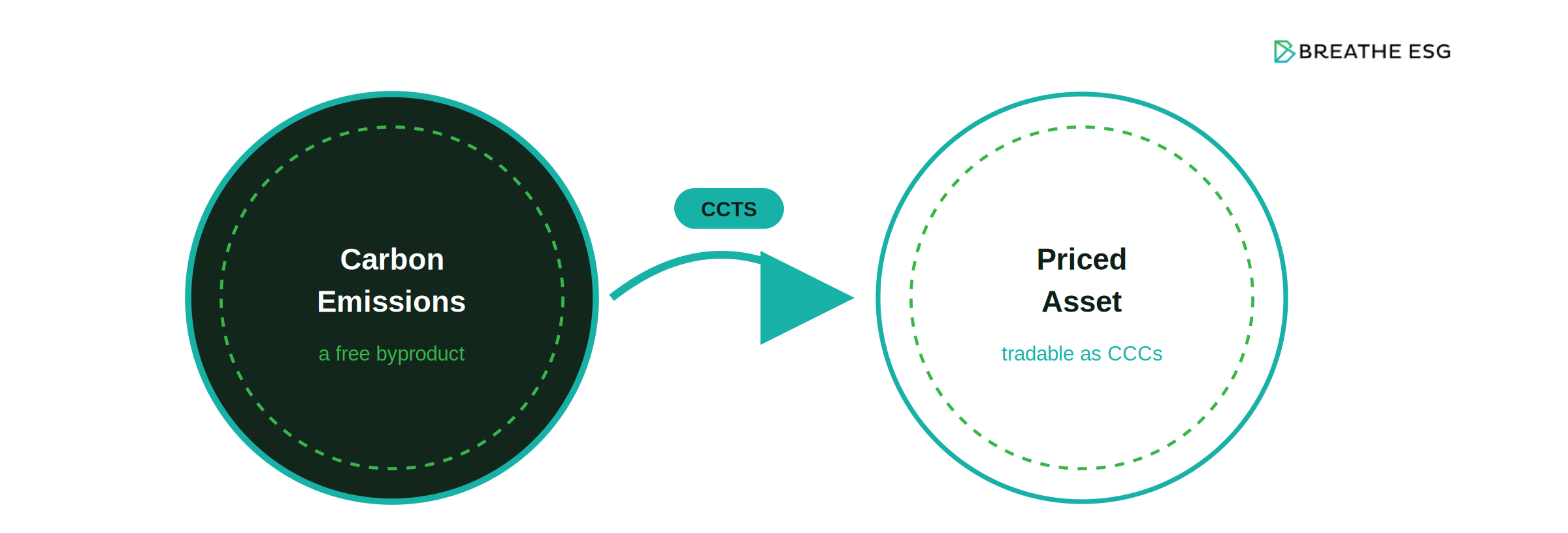
Put simply, CCTS turns carbon dioxide from a free byproduct of industrial activity into a financial asset or liability. Companies that cut emissions faster than their assigned target earn tradable Carbon Credit Certificates (CCCs). Companies that fall behind have to buy CCCs from the market to cover the gap, or pay a penalty.
Who Administers the CCTS?
The India carbon credit trading scheme is not run by a single authority. It works through a multi-stakeholder structure. The Bureau of Energy Efficiency (BEE) administers the scheme, recommends target sectors, and issues CCCs.
The Ministry of Environment, Forest and Climate Change (MoEFCC) notifies the actual GHG emission intensity targets. The Central Electricity Regulatory Commission (CERC) regulates trading of certificates on power exchanges. Grid Controller of India Limited (GCIL) operates the ICM Registry, where entities register and certificates are issued, tracked, and retired.
The National Steering Committee for the Indian Carbon Market (NSCICM), co-chaired by the Power and Environment secretaries, oversees the overall framework.
The India Carbon Credit Trading Scheme Launch Date and Rollout Timeline
Before getting into compliance mechanics, it helps to know the actual India carbon credit trading scheme launch date and how the rollout has unfolded, since obligations differ depending on which phase your sector falls into.
The scheme was legally enabled in 2022 through the Energy Conservation (Amendment) Act, and officially notified in June 2023, marking the formal India carbon credit trading scheme launch date.
From there, rollout has been gradual rather than immediate. Institutional groundwork, including registry design and the PAT-to-CCTS transition for the first sectors, took shape through 2024 and 2025. GEI targets for the first four sectors, alumminium, cement, chlor-alkali, and pulp and paper, were notified in October 2025, covering roughly 282 entities.
A second round covering petroleum refining, petrochemicals, and textiles followed in January 2026, pushing the total closer to 490 or more entities. The first official compliance-market trades of CCCs are expected around mid-2026, per statements from the Ministry of Power.

How the CCTS Compliance Mechanism Actually Works
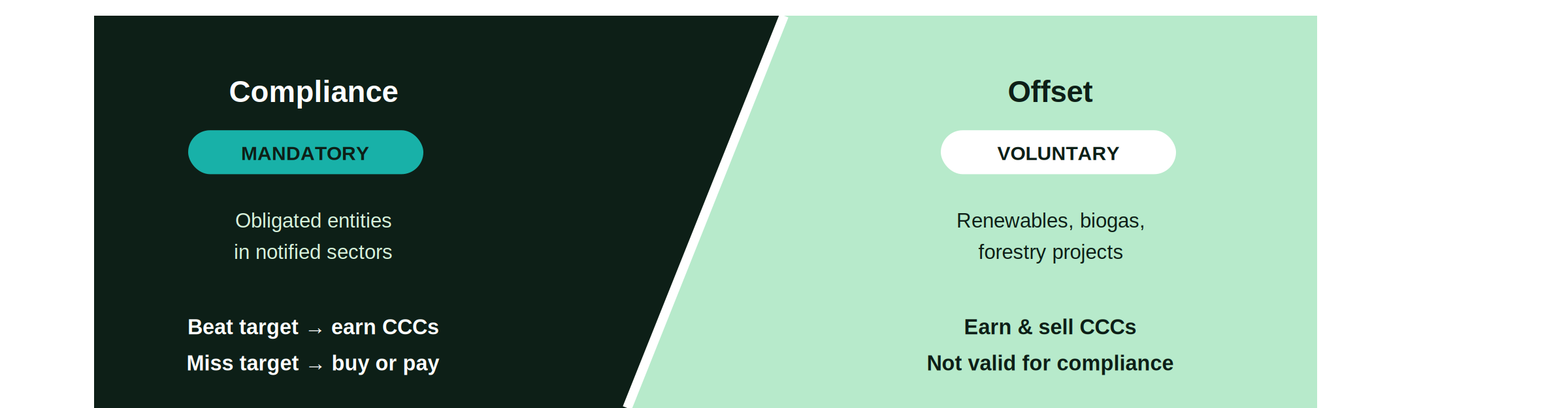
Carbon credit trading scheme India operates on two parallel tracks, and it's worth keeping them separate in your head.
The Compliance Mechanism Is Mandatory for Obligated Entities
This applies only to "obligated entities," industrial units in notified sectors that cross a defined energy consumption threshold. If your facility is on the list, participation isn't optional. The cycle works as follows:
- BEE and MoEFCC set a Greenhouse Gas Emission Intensity (GEI) target for each obligated entity, using FY2023-24 as the baseline, for a defined compliance period (currently FY2025-26 and FY2026-27)
- Entities submit GHG emissions data (Form A), verified by a BEE-accredited Carbon Verification Agency (ACVA), by 31 July each year
- BEE reviews the submitted data against the notified target
- Entities that beat their target receive CCCs for the surplus reduction; entities that miss it must purchase CCCs or pay environmental compensation
- All issuance, holding, and trading happens through the ICM Registry (GCIL) and recognized power exchanges under CERC's rules
The scope of what counts is fairly comprehensive. It uses a "gate to gate" approach covering Scope 1 emissions (direct combustion and process emissions) and Scope 2 emissions (purchased power and heat), along with certain Scope 3 categories such as imports and exports of intermediate products.
The Offset Mechanism Is Voluntary
Entities not covered under the compliance mechanism, such as renewable energy, biogas, green hydrogen, afforestation, and waste management projects, can register voluntarily, run emission reduction projects, and earn CCCs to sell into the market. This is closer to the familiar project-based carbon credit model, similar to CDM, but domesticated under the ICM.
One important nuance: offset credits currently cannot be used by obligated entities to meet their compliance targets. The two markets exist side by side but aren't yet fungible.
Which Sectors and Companies Are Covered Under CCTS?
CCTS rolls out sector by sector, not all at once.
Reduction targets vary by sector and sub-sector. As illustrative examples, cement entities face intensity reductions in roughly the 4.7% to 7.6% range over the compliance period, alumminium 2.8% to 7.06%, chlor-alkali 3.3% to 11%, and pulp and paper up to 15%. Targets are typically back-loaded, meaning a smaller share of the reduction is expected in year one, with the bulk due in year two.
If your facility sits in one of these sectors and crosses the notified energy or production threshold, you don't get a choice about whether to participate. BEE designates you as an obligated entity automatically, and the clock starts running from that notification.
What Registration Under the Carbon Credit Trading Scheme Actually Involves
Whether you're mandatorily obligated or voluntarily opting into the offset market, you cannot trade a single certificate without first registering on the ICM Registry, operated by GCIL. What that process looks like depends on which side of the carbon credit trading scheme you fall under.
Registration Steps for Obligated Entities
- Confirm your notification status against the BEE and MoEFCC sector notifications for your industry
- Register with GCIL within the prescribed window after notification, submitting entity details and the applicable fees under CERC's rules
- Receive your Certificate of Registration. This is a hard gate; no registration means no trading and no receiving CCCs
- Submit annual GHG emissions data (Form A), verified by an ACVA, by 31 July each year
- Track your position against your notified target and either receive CCCs or purchase them as needed to close any gap
Registration Steps for Non-Obligated Entities
- Register as a non-obligated entity on the ICM Portal
- Develop a Project Design Document (PDD) under a BEE-approved methodology for your emission reduction project
- Engage an ACVA to validate the project and address any corrective action requests
- Submit the PDD and validation report to BEE for registration and Technical Committee approval
- Implement and monitor the project, and engage an ACVA for re-verification at the end of each monitoring period to earn CCCs
What Happens If a Company Isn't CCTS Compliant?
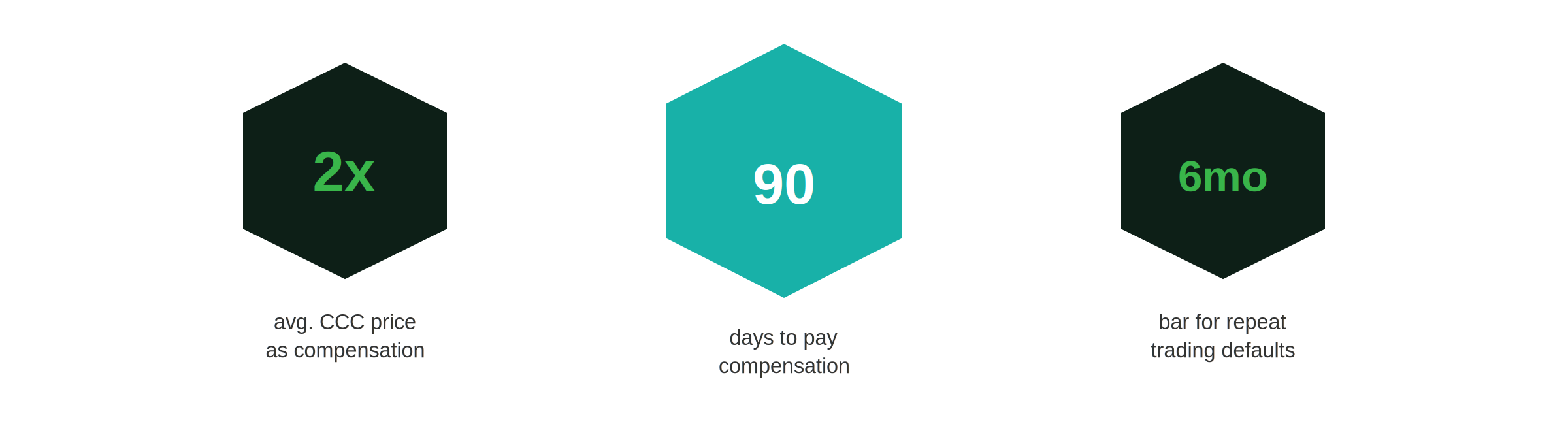
This is the part that tends to get attention fastest. If an obligated entity misses its GEI target and doesn't cover the shortfall by purchasing CCCs, it becomes liable for environmental compensation equal to roughly double the average traded price of Carbon Credit Certificates for the relevant compliance period, payable within a defined window commonly cited as 90 days.
On the trading side, CERC's rules carry their own enforcement teeth. Entities cannot bid to sell more certificates than they actually hold in the registry, and an entity that does this more than three times in a single quarter can be barred from CCC trading for six months.
This is a separate, trading-conduct penalty from the 2x environmental compensation charged for missing a GEI target
In short, staying CCTS compliant isn't optional guidance, it's a defined financial penalty tied to market price, plus reputational and regulatory exposure that follows a listed or large company into its ESG disclosures, lender conversations, and BRSR filings.
How CCTS Connects to BRSR, CBAM, and Global Carbon Pricing
The carbon credit trading scheme in India doesn't exist in isolation. A few connections matter for anyone building a compliance strategy.
Companies already reporting Scope 1 and Scope 2 emissions under SEBI's BRSR framework will find their CCTS emissions data and BRSR disclosures need to tell a consistent story, since auditors and analysts increasingly cross-check the two.
Indian exporters in steel, alumminium, cement, and fertilizers also face the EU's Carbon Border Adjustment Mechanism (CBAM) starting in 2026, and a clean, verified emissions baseline under CCTS gives them a stronger foundation to demonstrate embedded carbon costs.
More broadly, roughly 89 countries now price carbon in some form, covering about a quarter of global emissions, and CCTS is India's way of getting ahead of that curve on its own terms rather than having carbon costs imposed externally through trade mechanisms.

How Breathe ESG Helps You Stay Compliant With CCTS
Reading the regulations is one thing. Actually operationalizing it, tracking Scope 1 and 2 emissions at the facility level and building toward your notified GEI target, is a very different job, especially if you're managing this across multiple plants or business units.
Breathe ESG brings your ESG disclosures, including BRSR, onto a single source of truth, so the same verified emissions data feeding your CCTS intensity tracking doesn't need to be recreated separately for other frameworks. The platform is built around 1000+ curated KPIs, customizable dashboards, and granular access controls, which matters when multiple plants or business units are each contributing data toward one consolidated emissions picture.
Breathe Zero, the company's dedicated emissions and decarbonization solution, is where the more technical CCTS-relevant work happens. It calculates Scope 1, 2, and 3 emissions in line with the GHG Protocol, giving you the granular facility-level data that any GEI intensity calculation depends on.
Bulk uploads and API integrations keep that data centralized and consistent across facilities and years instead of scattered across spreadsheets. Emission hotspot analysis helps pinpoint exactly where a plant is furthest from its target, and target-setting tools let you break a multi-year reduction goal into manageable annual milestones with ongoing progress tracking.
Book a demo today to streamline CCTS compliance with Breathe ESG.
FAQs
What is CCTS in simple terms?
CCTS, or the carbon credit trading scheme, is India's national carbon market. It sets emission intensity targets for energy-intensive industries and lets companies trade Carbon Credit Certificates based on whether they beat or miss those targets.
Who needs to comply with the carbon credit trading scheme?
"Obligated entities," industrial units in notified sectors like cement, aluminium, textiles, and chlor-alkali that cross a defined energy consumption threshold, must comply. BEE designates these entities automatically once a sector is notified.
What is the India carbon credit trading scheme launch date?
The scheme was officially notified in June 2023, marking its formal launch date. Sector-specific compliance obligations followed later, with the first GEI targets notified in October 2025.
What happens if a company isn't CCTS compliant?
The entity must purchase CCCs to cover the shortfall or pay environmental compensation, roughly double the average traded CCC price, within about 90 days. Repeated defaults can also lead to trading suspension.
Can voluntary offset credits be used for compliance obligations under CCTS India?
No. Offset Mechanism credits, earned by non-obligated entities through projects like renewable energy or afforestation, currently cannot be used by obligated entities to meet their compliance targets.